

Rome. Bloated of bodies, golden light spilling down long, windless alleys. The Temple of Hadrian looking at us, looking at it. Heat like being choked, heat like sex. Indulgence everywhere, and I know I am just one of the carnal many, but I am trying to offer myself to Rome—how?—rather than extract from it. I am trying to listen to it.
The very moment I set foot on Italian earth, my period—which was late, of course—arrives, like an exhale. My body knows this terrain on a cellular level; a key that fits. I feel at home in Italy the way you feel at home with an old lover: Mostly inherent at its core, sort of like talent. It can’t truly be generated. It is only innate and then given time to bloom.
~~
The waiters are aggravated and ready to blow. One waiter tries to stiff me 5 euro; it’s definitely on purpose; most of the others are a delight. It’s my second time in the city, and I know what to expect. I try to be kind, to speak in Italian, to impose nothing of myself onto Rome’s exhaustion, but we’re in the bloodletted centro, and it is filled with entitlement, an ancient Disney adventureland of sweaty hungry loud fucks.
I can’t help but see the cracks in the facade. People crack it. Am I a crack? But the beauty wins, because that is what beauty does. It supercedes all else; it is a human compulsion because we are afraid of death and because we are good at devotion. Roman beauty is often unrefined and mammoth and sacred, terracotta walls chipping, gilded by the time’s audacious hands, dotted with the gods.
~
I wake in an old family B&B to the steady sound of hard, dark rain; Rome exhaling. I learned the word for darkness only the other day: il buio. It doesn’t sound like it feels. The thunder shakes the shutters at my windows, and a small burst of wind squeezes through the glass, gasping. I pull the gauzy curtains shut to keep the remaining light out, and then I just listen before falling back into a woozy sleep.
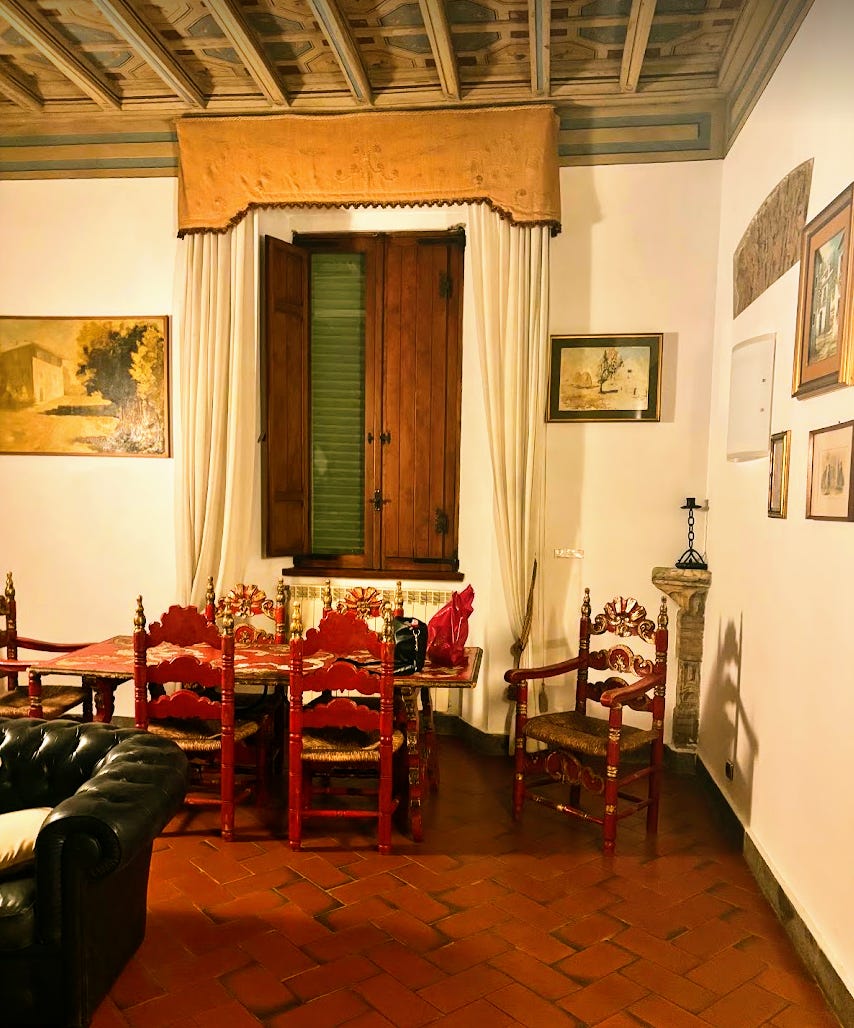
The apartment is up 70 gorgeous, tiled stairs in an old building built for everyday life, for families. Renaissance-style chair, medieval candelabras, and heirlooms remain throughout, some locked behind curio glass: a dozen blood-red goblets peer at me from behind the panes. Yet it maintains its austerity.
This b&b is not a set or an act. This was a family home, surely; it is preserved, haunted, and I am an intruder. Did a whole family line die, leaving some relative to squeeze money out of a dark hole of loss? Or has this home been turned over to new hands, people who sublet to strangers a space where generations had babies and cut lemons and washed their hair and swept the floors?
My friend tells me every house has that story, but it feels more real here. Everything is perfectly preserved, even the body-sized dips in the middle of the mattress. Armoires that no doubt held wedding dresses 100 years ago. We put our lips on the same glasses. We are touching their mouths with our mouths.
~~
In bed, I imagine I am a young girl and that this is nonna’s house, the nonna I had but never truly had. That I am lying in bed with my throbbing period cramps in the dark. Nonna comes to my bedside with something sweet. She puts her hand on my head; thumbprints of the cross; she whispers something.
I listen to her putter up and down the long tiled halls, the soft swoosh of an imbalanced gait. I let myself slip into the velvet cocoon of sleep. I think of my real grandmother, from Sicily—of her perfume and her prayers but also her cruelty, of what made her that way.
~~
R and I dress up and walk to a restaurant with a subterranean cellar-style dining room said to be part of the complex where Julius Caesar was brutally murdered by his cohorts; his death was considered the start of a chain reaction that eventually beget the Roman Empire. We eat dinner between heavy, cool, deep stone walls, a carved-out chamber adorned with thick red velvet curtains. Carciofi and red wine are served while diners imagine his blood pooling beneath our feet. We look toward the darkness of the past and yet we cannot help ourselves—we must repeat it.
~~
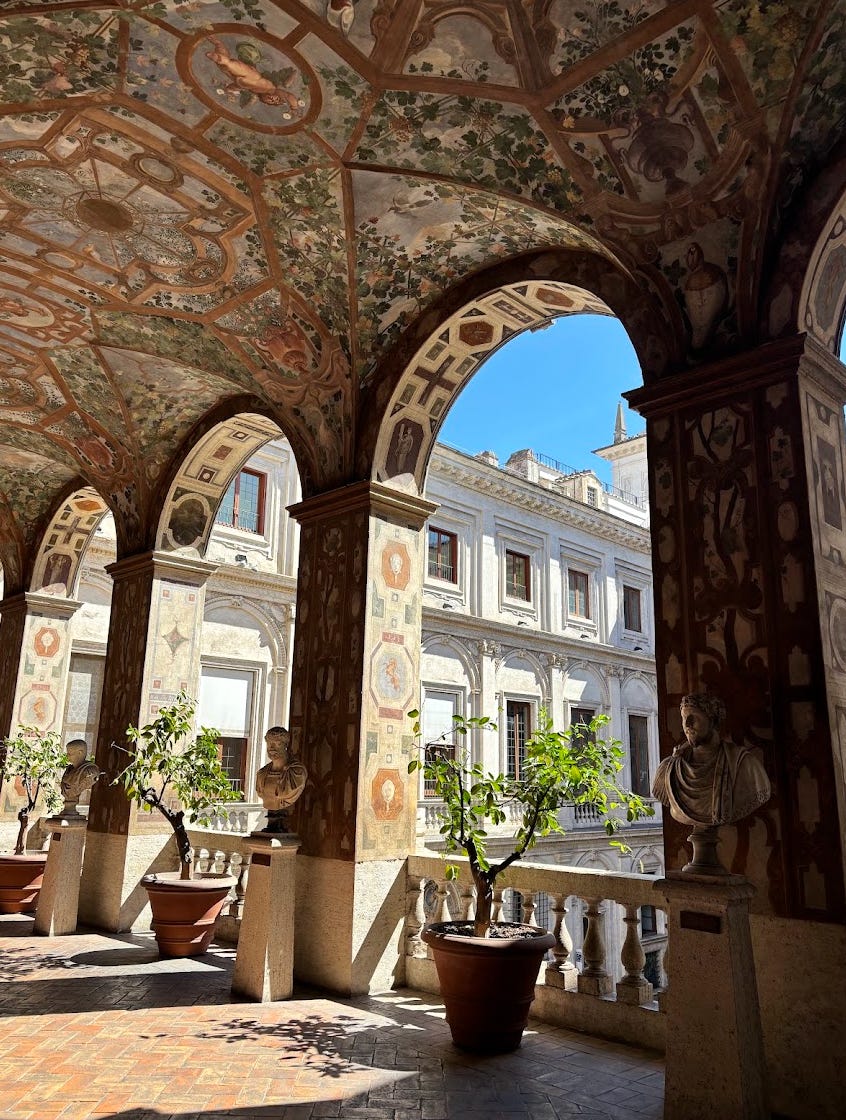
At the Museo Nazionale Romano at Palazzo Altemps, we spend an entire slow afternoon with the Gods. There are sun-drenched terraces adorned with saffron murals of birds and plants; the sculpted stone limbs of Demeter and Apollo lounging in the high noon sun; amphorae and funerary reliefs and bones.
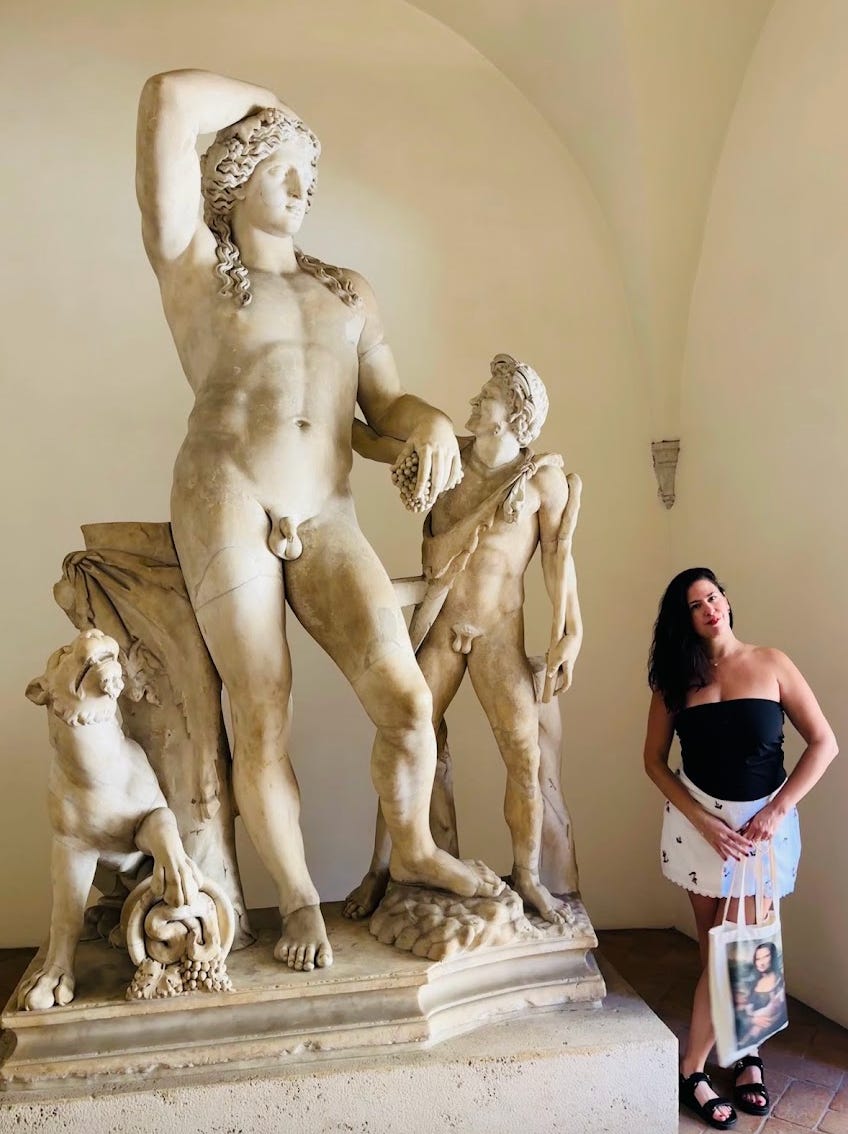
I am particularly drawn to Dionysus/Bacchus—always have been, with his pinecones and staff and grapes. I linger in rooms with him, wishing the sculpture would talk back to me. Like a child I covet his attention.
I have always longed for and feared the ecstatic. As a Scorpio, as a writer, I am always tugging at the precipice of ruin, peering behind its delicious curtain. I want the rush of abandon, and then I run from it. An erotic push-pull, where the threshhold is my kink.
Dionysus is the embodiment of The Me that Stretches Beyond Fear, into an erotic expanse that verges on the divine. It is the part of me that eats to excess and drinks and dances and gets lost in beauty and uses my sensuality as currency and lets go of expectation and order. Dionysus tells me to write poems, to lose my fucking mind. But it’s less about the wildness itself and more about what it takes to get there.
In Rome, the closest I get to bacchanalia is staying up late, laughing with my friend and the ghosts, drinking dark, thick wine and smoking a dozen slim Vogue cigarettes. My friend called our last night a “loopy giddy fever dream.” Dionysus would approve.
And then when things feel too heavy, I pull back on the ecstatic, march down the hill, pass through the scrim, and become good again.
~~
I ask Artemis, protector of young girls, to bless the young girl in me. To bless the Me today. I daydream that I am one of her arkteia, in my golden robes, dancing in the woods and roaring feral as a little bear.
~~
A scarcity mindset follows me to Rome.
I remember that in real life I live in urban New Jersey and I come from food stamps and foster care and I have no family money or trust fund or inheritance, that I managed to scrape together this, this, this life for myself; that I am as blessed as the gods—and it wasn’t a gift and it wasn’t a given and it wasn’t easy. I find myself thanking every God I come across, as if I didn’t deserve it, as if I duped fate, as if only some people deserve access to beauty and the divine.
~~
On Isola Tiberina, the Basilica of San Bartolomeo all’Isola, built in 988, sits directly on top of the ancient Roman temple of Aesculapius, an ancient Greek god of medicine and healing. There is no Roman counterpart; the Romans adopted him. Fittingly, the island is also home to a a working hospital & a farmacia (where I buy SPF 50 because Rome is an oven and I am but mortal).
The Tiber’s rushing waters hold the island like two cupped palms. I close my eyes and lose a whole moment as I stand on the bridge, listening to the water’s movement, healing from beneath my feet. My friend, waiting in the blistering sun, said I disappeared somewhere.
The temple can be seen if you follow the stairwells down down down into the earth below the chapel. There is a glass floor encasing the remnants of the temple. I have stared and stared at this earth, asking for Aesclepius, with his serpentine staff, to hear me, to heal my mother, to help me stay mobile after spinal injury. Strange as it is, a part of me sincerely believes he hears me. I can feel his snake slithering up my legs from the river.
~~
After walking 13,000 steps I find myself in bed too exhausted to move yet too entranced to sleep. I think for hours about ancient Roman Paganism, about how a Roman would have relations many gods—gods in the home, gods in public life, and how these gods had relationships with one another. And about how eventually Emporer Theodosius banned the worship of the people’s gods, making Christianity the official state religion of the entire Roman Empire.
I thought about what lasts. What survives. How beliefs are hidden, blended. What finds a way beyond codification and control. What exists beneath the beneath, how you can bury something and build something on top but the arteries are always full of blood underneath. Gushing, like embalming and body fluids pushing the cracks of a mausoleum wall. How we contain multiplicities.
I thought about how I passed the Temple of Venus Genetrix and the Temple of Portunus and how we drank lambrusco outside the the Pantheon at dusk. I thought about how the dominant structures try to erase us, and how we resist, even when it feels futile. Resistance comes natural, as does tyranny.
~~
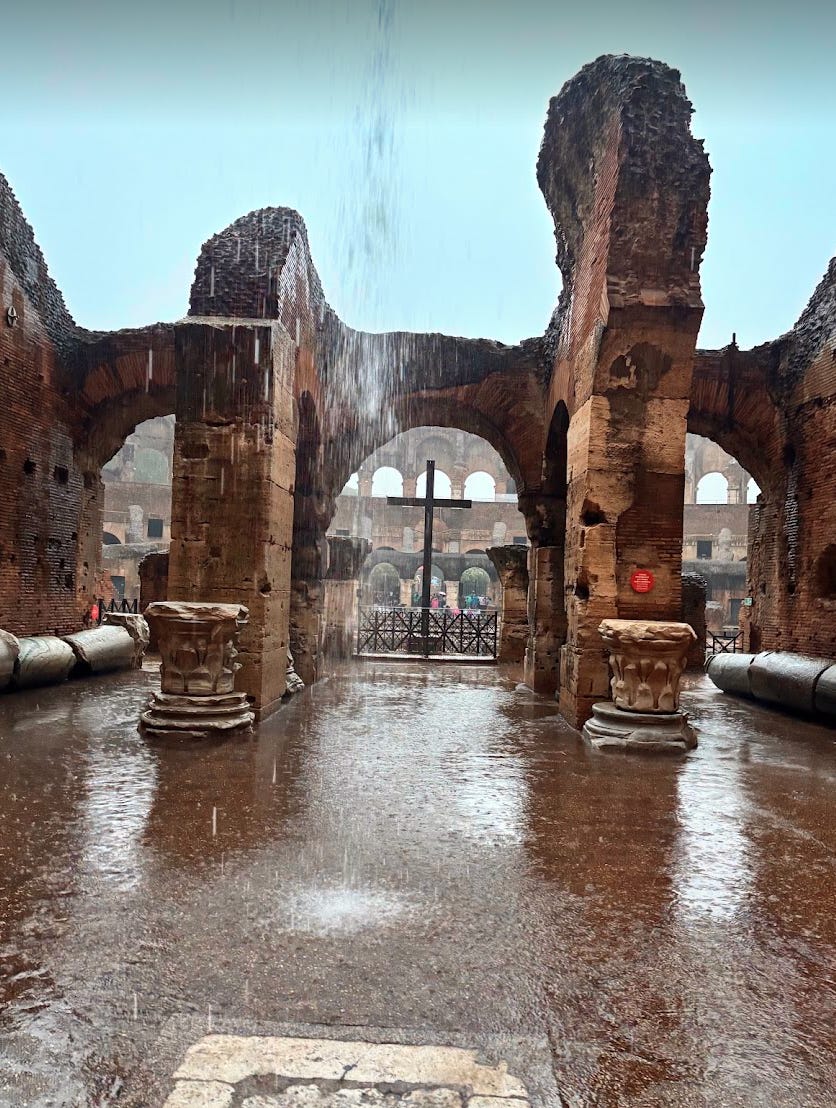
We enter the Collosseum during a barbarous thunderstorm. After passing the Roman Forum and Palatine Hill that grey, almost-rainy afternoon, the skies threw a fucking tantrum. We entered the Collosseum in a fit, all of the bodies crammed into the enterance, sideways rain slamming us, lightning flashing through the center arena.
The structure itself is incredible, with its winding internal facade, its hypogeum and seating (it holds up to 75,000 people), but I mostly felt its heavy cloak of grief—the immense and ceaseless violence, the Roman’s slaves worked until death, bodies fighting until they were worthless if not dead, the captive and killed animals. So, I dashed out between thunderstrikes to capture photos, and I felt myself as spectator. Just like the Romans.
Follow me on IG for more photos and details.
this is so rich!!!
so lushly described! really appreciate your work.