

I arrived in Europe a few days ago. Yesterday I was still—still!—in the lethargic abyss of jet lag, which I cannot ever seem to shake, and which happens whenever I travel. But yesterday afternoon, I pulled myself from the bed when I realized my favorite writers were at Montparnasse.
I had to make the pilgrimage, of course. I walked in through the cemetery’s gorgeous gateways, brick walls under a coverlet of dense green, little blue birds flitting through the bushes.
I found her first.
I found my most beloved prose writer, Marguerite Duras. Just saying that feels as though I am a child and my favorite color is blue, or yellow. She is every color. If you know Duras, you know her work and life are things of pain, truly. And also immense passion, contradiction, expression. A constant looking back at childhood, at what is no longer, at the mother wound, the father wound. She told me early on that The Wound is the thing to be obsessed over, stoked, and alchemized. Abandonment, family dysfunction, alcoholism, douleur; these things pervaded her inner world, and she chased them on the page.


I did not expect this, but standing at her tomb, I felt a tenderness toward this woman I have never met and could never truly know. I suppose I wanted to see her grave to ask if she is alright, and to also be tended to by her as a woman and as a writer.
As I moved through the glittering carousel energy of Paris, I imagine her in these streets with her contemporaries, at cafes and bars, creating beauty while she moved through her own shadow. I asked her to bless me.
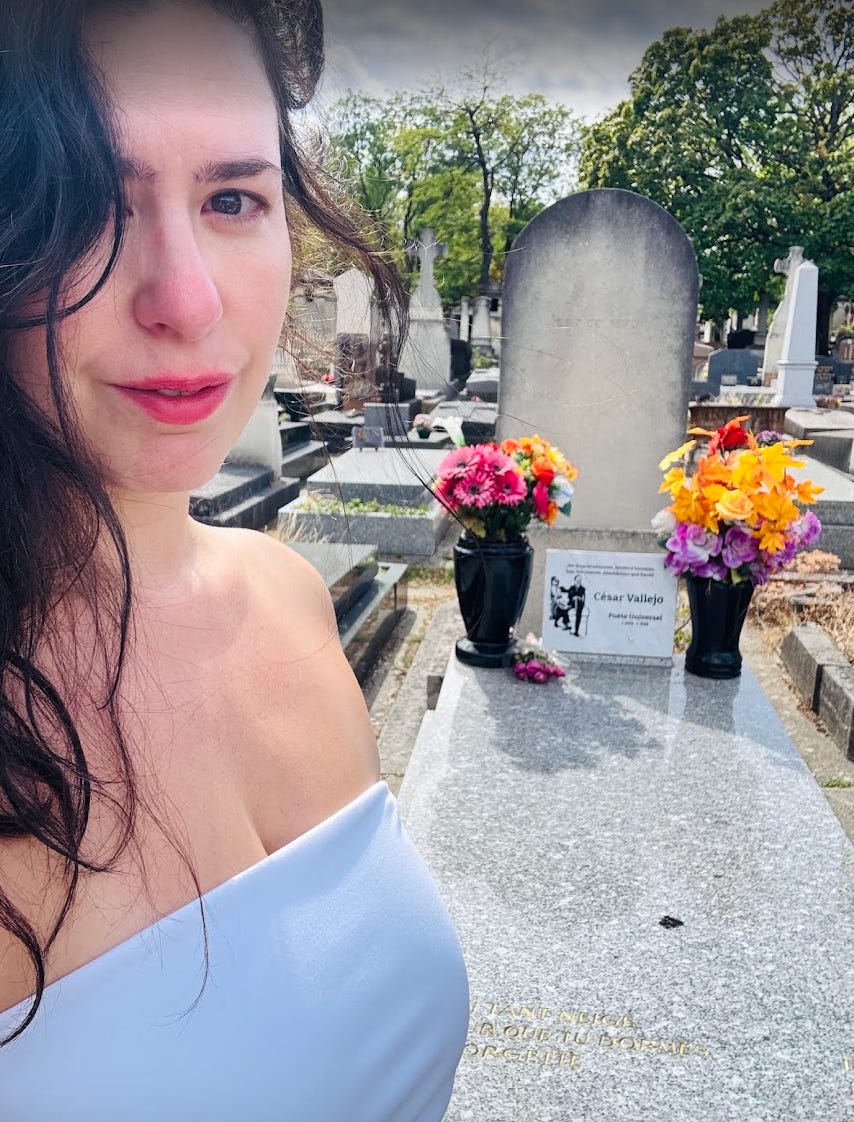
And then I went to César Vallejo, whose grave is tucked into a row. It is easy to miss, even with directions. Vallejo is the reason I ‘became’ a poet—not just dabbled in it. A friend of mine in college, Lisa, gave me a translated copy of his book Spain Take This Chalice From Me (note: there are other translatons of this title). It became my heart because he taught me the heart of poetry could be difficult, could be violent, could be wild and surreal.
His avant-garde tendencies (he even used automatic writing) and darkness showed me new doorways, new permissions. I was young and didn’t understand the politics of his world then, but I knew the language had a ferocity that could contain and express human suffering. He is the reason I love bold language, strangeness, fucked up syntax, the visceral, the embracing of the ugly and warped and broken. Seeing him moved me deeply. I thanked him profusely. I asked him to bless me.
And then I walked over to see Sartre and Simone de Beauvoir, together in death, in a perpetual heaven-talk about existence, their graffitied tomb covered in offerings. A young girl stood beside me crying, elated. She left flowers.
The wind was strong in Paris yesterday, and it felt the dead had acknowledged us at Montparnasse.


Forgive the brevity and simplicity of this missive. I am tired and my bones ache and my head is still a swirl of strange hours.
Lovely! I love Montparnasse- the cemeteries in Paris are just so magical
So lovely <3